Smart Water Softeners and the Rise of HydroLink Monitoring: What Wi-Fi Adds to a 60-Year-Old Technology
Modern softeners can text you when salt is low, track your water usage in real time, and cut salt consumption by up to 50%. Here's what smart features actually deliver — and which ones are worth paying for.
Water softeners are one of the oldest technologies in a modern home. The ion-exchange process at the heart of every softener sold today was patented in 1905. For decades, the industry innovated on capacity, size, and efficiency but not on user experience — you set a mechanical timer, you watched the salt tank, you called someone when things went wrong. That started to change in the 2010s with the arrival of demand-initiated regeneration, and it's changed again dramatically in the last five years with connected 'smart' softeners like EcoWater's HydroLink-equipped systems.
The obvious question: does any of it actually matter, or is it just a way to charge more for water treatment? Here's an honest look at what a smart softener adds, and what it doesn't.
The mechanical foundation
Even the smartest softener still relies on decades-old chemistry. Water flows through a tank of ion-exchange resin. The resin swaps sodium ions for calcium and magnesium ions, removing hardness. Eventually the resin fills up with hardness minerals, at which point it has to be 'regenerated' by flushing it with brine (concentrated salt water) that displaces the accumulated minerals and washes them to drain. The whole cycle repeats — usually every few days for an average household.
The traditional way to trigger regeneration was a mechanical timer. Set it to regenerate every 3 days at 2 a.m. and hope your water usage matched the schedule. Sometimes it did, and you got adequate softening at reasonable salt consumption. Often it didn't. Homes with fluctuating usage would either run out of soft water on high-demand weekends or waste salt regenerating a tank that was still 80% loaded with capacity.
Demand-initiated regeneration: the first big leap
The first generation of smart softeners added a flow meter. Instead of regenerating on a fixed schedule, the system tracked actual water usage and regenerated only when the resin was close to exhaustion. That single change cut typical salt and water usage by 25% to 40% for most households. It's the reason a modern softener uses so much less salt than one from the 1990s.
Every softener we install today has demand-initiated regeneration. If you're shopping and see a purely time-based softener at a big-box store for $500, that's what you're looking at — an outdated design that will cost you more in salt and water over its lifetime than the up-front savings.
What HydroLink and Wi-Fi actually add
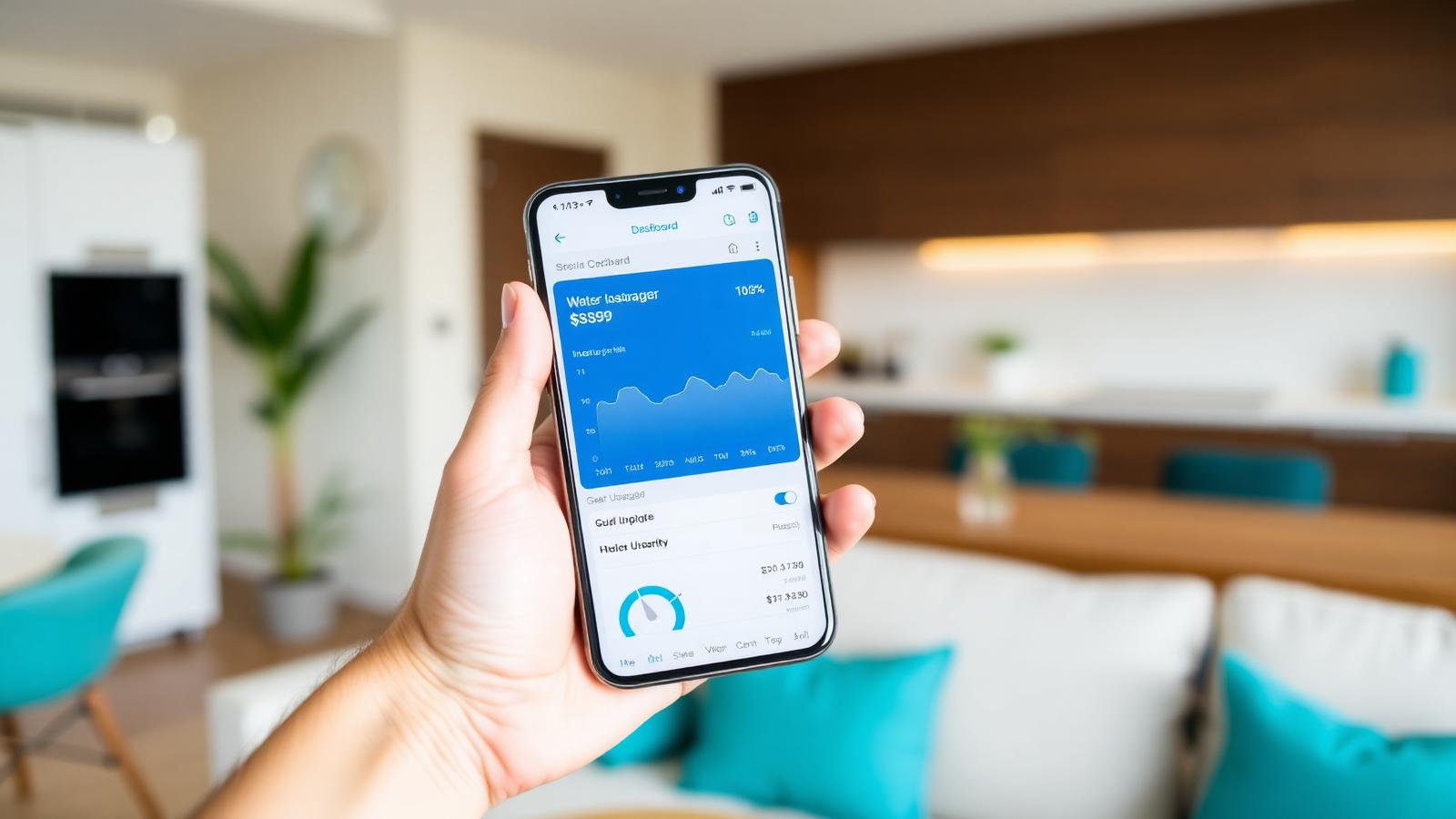
The next layer of intelligence — HydroLink on EcoWater systems, similar platforms on other brands — connects the softener to your home Wi-Fi and gives you a full monitoring dashboard on your phone. In practical terms, that's a handful of things:
- Real-time water usage tracking: see how many gallons you used today, this week, this month. Break it down by household or by fixture with add-on sensors.
- Salt level monitoring: the system alerts you when the salt tank drops below a threshold, no more forgotten checks or last-minute Sunday trips to the store.
- Flow anomaly detection: unusual usage patterns (a running toilet, an outdoor leak, a burst pipe while you're on vacation) trigger a notification. This is one of the most under-appreciated benefits — it has caught leaks in customer homes that would have caused thousands in damage.
- Service diagnostics: your dealer can log in remotely (with your permission) to check the system's health, diagnose issues, and schedule service before something breaks.
- Regeneration history: transparency into when and how much salt the system is using, which helps optimize settings over time.
None of these are life-changing individually. Collectively, they turn a set-and-forget appliance into something that actively saves you time, money, and the occasional water disaster.
The salt savings, quantified
EcoWater's own testing, corroborated by independent Water Quality Association benchmarks, shows that a modern HydroLink-equipped softener uses roughly 50% less salt than a time-based system from 15 years ago, and about 25% less than a basic demand-initiated system from 5 years ago. For a Sioux Falls family that goes through 200 to 300 pounds of salt per year on an older system, that's a real 50 to 100 pounds saved annually — measurable both at the checkout counter and at your septic system, if that's how your wastewater is handled.
The leak-detection story
This is the feature customers write us about most often, and usually the story goes something like this: 'I got a notification on my phone that our water usage was three times normal. I was at work. I called my wife, she found a toilet running upstairs, we fixed it in five minutes. That single alert paid for the system.'
Water damage is one of the most common and expensive homeowner insurance claims — an average paid claim runs over $12,000 according to the Insurance Information Institute. Anything that catches an unusual flow pattern within hours instead of weeks is worth having.
What smart features don't add
The Wi-Fi doesn't make the water any softer. The chemistry is the chemistry — a HydroLink system removes the same hardness minerals as an unconnected model of the same size. If your primary concern is water quality and you don't care about monitoring, a mid-tier softener without the connected features will deliver the same water at a lower price point.
Connected features also add complexity. Wi-Fi outages, app updates, and occasional firmware quirks are part of the deal. For most customers this is a non-issue — the app works well, EcoWater's support is responsive, and the underlying softener continues to work perfectly even if the network drops. But if you're deeply hostile to internet-connected appliances on principle, that's a legitimate reason to buy something simpler.
Who should pay extra for a smart softener
Our honest recommendation: most people should. The salt savings alone pay for the upgrade over the life of the system. The leak-detection is a genuinely valuable insurance-adjacent benefit. And the ability for a technician to diagnose remotely (rather than driving out for a service call) saves money on the back end as well.
The customers we don't recommend the connected upgrade to are people who don't have reliable home Wi-Fi, people who don't want to use apps for anything, and rental property owners who don't want to manage another connected device. For everyone else, it's the default at this point.
Setup and privacy
The HydroLink app is straightforward — you connect the softener to your Wi-Fi during install, create an account, and pair it. Data is stored securely and used for the monitoring dashboard; EcoWater doesn't sell or advertise against usage data. You can revoke dealer access at any time if you don't want us seeing diagnostics.
The bottom line
Wi-Fi didn't reinvent the water softener. But it turned a 60-year-old appliance into something meaningfully better — quieter to own, cheaper to run, and occasionally a lifesaver when a pipe bursts or a toilet gets stuck open at 3 a.m. If you're already replacing a softener, the connected upgrade is usually the right call. If you're happy with what you have, there's no urgent reason to swap it out. That's how simple and how honest the answer actually is.
Get your water tested — free
We'll come to you, measure your water, and recommend the right fix. No pressure.
Book a Free Water Test